
ATMOSFAR Early Access Review: A Flying Base Worth Building
An honest ATMOSFAR Early Access review: ship-building is excellent, the survival loop is coherent, and the launch build is still rough. Buy or wait?
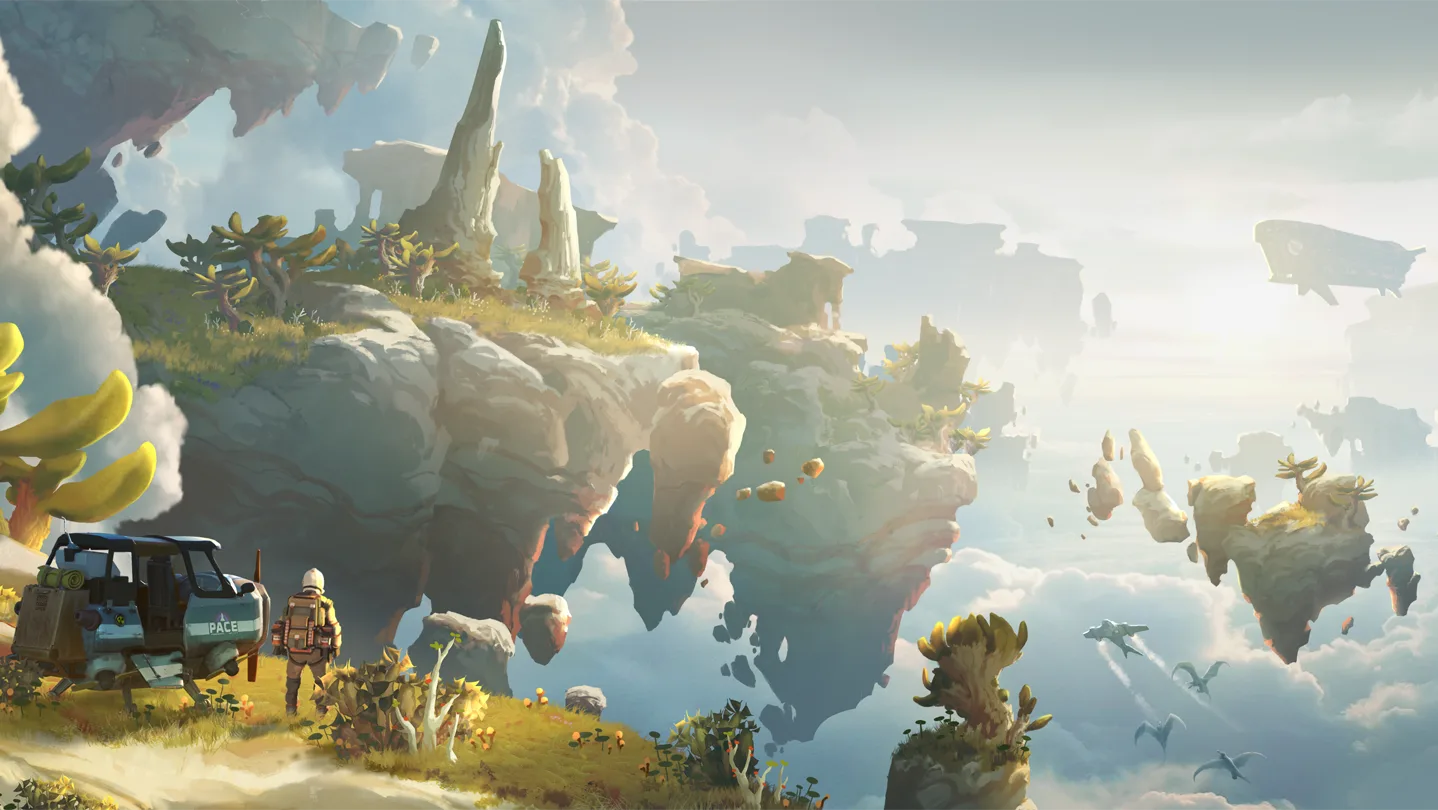
ATMOSFAR's Early Access build is a good survival-crafting game with an exceptional centrepiece: a modular flying base you actually live in. It is also unfinished, occasionally janky and missing a third of its world. Buy it for the building, not for the story.
Provisional verdict: recommended with caveats. This is an assessment of the launch build, not a finished-game review. The 1.0 release is expected in 9–12 months.
What ATMOSFAR gets right
The Cloud Cruiser is a real idea, not a feature bullet
Most survival games give you a base. ATMOSFAR gives you a base that flies, and then makes that fact matter. The ship is not a menu; it is a physical object with weight, lift, power, fuel and rooms. You build the hull, place the reactor, hang the balloons, park the Wasps and fly the thing to the next island.
That single design decision reorganises the entire game. Scrap is not just crafting material; it is mass. Fuel is not just a timer; it is a cold-storage problem. A second player is not just extra DPS; they are a second pair of hands on a hull section.
The power and lift budgets are legible
ATMOSFAR's systems are unusual in that they can be explained in a paragraph. Power is units per second. Lift is balloon volume versus weight. Fuel is liquid hydrogen that evaporates if you lose cooling. A player who understands those three sentences can diagnose almost any ship problem.
That is good design. It gives the building system depth without hiding the rules.
Co-op is built into the fantasy
Four-player online co-op is not bolted on. The ship has bunks, pads and workspaces for a crew, and the build mode supports multiple players hovering around the hull at once. The game is at its best when one player flies, one engineers, one salvages and one scouts.
The world has a point of view
Floating islands are common in games; floating islands caused by hydrogenogenesis, settled by a research colony that collapsed, are more specific. The vertical map, the PACE ruins and the unanswered questions give the sandbox a reason to exist beyond crafting.
What it gets wrong
It is Early Access, with the usual edges
- Two of three regions. The upper layer is visible and unreachable until the Rime update.
- An unfinished story. The launch arc does not conclude.
- Launch-day bugs. The first patch disabled DLAA temporarily and fixed a bug where research drives could be lost. Those are normal Early Access problems, but they are real.
- UI and onboarding. The game explains less than it should about power draw, lift and fuel storage. This site exists partly because the game does not.
Performance is a question mark
The minimum GPU is an RTX 2070, which is a high floor. The game is doing a lot of volumetric work, and Early Access performance is still being stabilised. If you are on older hardware, check the system requirements before buying.
Combat is the weakest pillar
The Striker is fun to fly, but the combat loop is thin: stun drones, avoid turrets, scare animals. It is a survival game with guns, not a combat game. If you want satisfying air combat, this is not it.
The grind can spike
Large-scale construction needs a lot of scrap, and the material processor is the only way to handle the biggest pieces. A player who does not build the industrial spine early will spend hours ferrying pipes.
How it compares
| Game | ATMOSFAR's difference |
|---|---|
| Raft | ATMOSFAR is vertical and aerial; the base moves in three dimensions |
| Valheim | More engineering, less combat; a single mobile base instead of many outposts |
| Subnautica | Same lonely exploration tone, but you build the vehicle you live in |
| Space Engineers | Less simulation, more survival; easier to learn, less free-form |
ATMOSFAR sits between the survival-crafting and vehicle-building genres. If either appeals, it is worth a look.
Who should buy it now
Buy it if:
- you enjoy building and optimising machines,
- you have a friend or three to crew the ship,
- you are comfortable with an unfinished game,
- and you want to learn the systems before the 1.0 price rise.
Wait if:
- you want a complete story,
- you need polished performance and UI,
- you play only single-player narrative games,
- or you are on hardware below the minimum spec.
The verdict
ATMOSFAR's launch build is not a finished game, and it does not pretend to be. What it offers is one of the more coherent building fantasies in the survival genre: a flying base that is genuinely yours, a world that justifies the flight, and a co-op loop that gives every player a job.
The caveats are real: two regions, an unfinished story, launch bugs and a high GPU floor. But the core is strong, and the roadmap is specific. If the idea of engineering a flying home appeals, this is the Early Access gamble worth taking.
Provisional score: 7.5/10. The score reflects the launch build, not the 1.0 potential.

Early Access footage from Tycos. Screenshots: Apog Labs / SHUEISHA GAMES.
FAQ
Is ATMOSFAR worth $24.99? Yes, if you like building and survival. The launch discount brings it to about $22.49.
How long is the game? There is no fixed campaign length. A first playthrough of the launch content is tens of hours; the building loop is open-ended.
Is it better solo or co-op? Co-op is better once you know the systems. Solo is the better tutorial.
Does it have a story ending? Not yet. The story continues in the Rime update and concludes before 1.0.
Should I wait for 1.0? If you want a polished, complete game, yes. If you want to build now and do not mind rough edges, no.
Sources
- ATMOSFAR on Steam — store description, system requirements and Early Access notes.
- ATMOSFAR Steam news hub — patch notes and developer posts.
- ATMOSFAR official site — Apog Labs announcements and media.
Related reading: ATMOSFAR Early Access Roadmap: Every Planned Update and ATMOSFAR Release Date and Price: What You Pay in 2026.
Source note: mechanics and figures in this guide follow the Early Access build available on 30 October 2026, cross-checked against the ATMOSFAR Steam page and Apog Labs developer posts.
More ATMOSFAR Guides
How crafting works in ATMOSFAR: crafting table, research desk unlocks, blueprint sources, material processing and the order to build tools and ship parts.
The animals, plantimals and machines that end ATMOSFAR runs: Screechers, Blisterbacks, Traproots, PACE drones and AA turrets, with counters for each.
The ATMOSFAR Early Access roadmap: Vagabond, Rime, Blue Side and Singularity updates, the Scout Wasp, the third region, 1.0 timing and launch content.
Find ATMOSFAR hydrogen crystals near geysers, harvest them safely, haul them with the Hauler and turn them into liquid hydrogen before your Wasp runs dry.
Run an ATMOSFAR hydrogen refinery without draining your camp: power draw, cold storage at -253°C, field vs ship refining, siphon top-ups and common failures.
How the ATMOSFAR map works: the floating layers of Tycos, where Caligo Cays sits, what Early Access includes and how to navigate without a full map.
ATMOSFAR released on 29 October 2026 in Steam Early Access at $24.99, with a 10% launch discount to $22.49. Platforms, editions and what comes next.
A practical map of ATMOSFAR resources: scrap, circuit boards, hydrogen crystals, wood, food, water, artefacts and cores, with where to look for each.